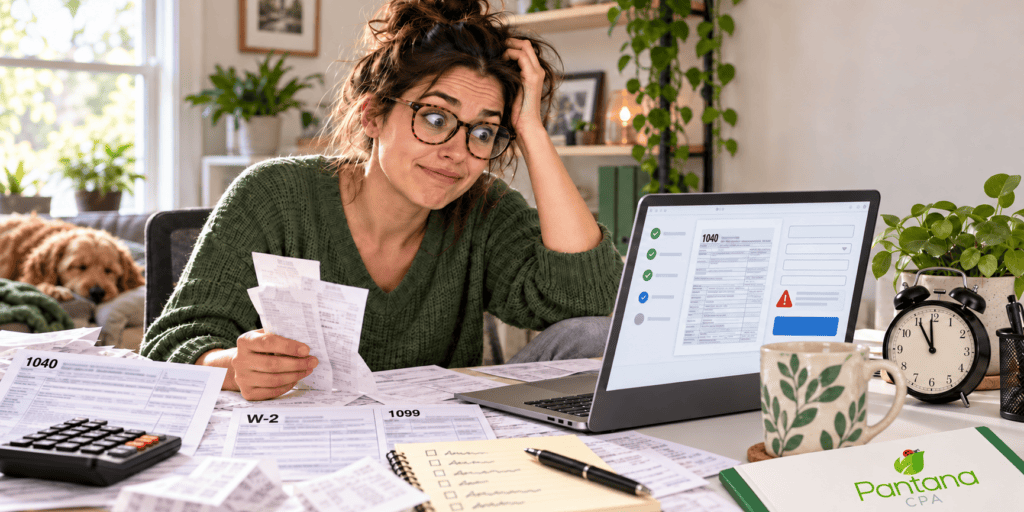
Avoid These Tax Season Pitfalls for your 2025 Taxes — Advice from Pantana CPA

The Most Common Tax Mistakes We See (and How to Avoid Them)
A CPA’s Perspective: What We Really See During Tax Season
Every year, as we sit down to prepare hundreds of returns, one truth becomes clear most tax filing mistakes aren’t about complexity; they’re about preparation and communication. Even the most well-intentioned taxpayers can overlook small details that have big consequences. Missing forms, incomplete information, and overlooked deductions can all lead to delays, higher tax bills, or letters from the IRS.
At Pantana CPA, we’ve seen just about everything from simple math errors to major missed credits. The good news? Nearly all of these mistakes are entirely preventable with the right planning and timely communication along with the expertise of a professional.
Here’s an inside look at the most common tax mistakes we see from the CPA’s side of the desk and practical ways you can avoid them.
Forgetting Important Documents
- From the CPA’s chair: Every January, we start receiving client paperwork, but by February, new W-2s and 1099s trickle in. Sometimes, clients file too early and later realize a brokerage or side job sent another form. That missing slip of paper can trigger an IRS notice or require an amended return.
- Why it happens: Many companies and financial institutions issue forms on different schedules. Investment accounts, for example, often send corrected 1099s weeks after the initial mailing.
- Avoid it by: Creating a secure digital “Tax 2025” folder on your computer or cloud drive.
- Waiting until mid-February before filing, most corrected forms have arrived by then.
- Using our Pantana CPA Individual and Business checklist help to make sure every expected form is in hand before we start.
- A few days of patience can save weeks of unnecessary amendments later.
Overlooking Deductions and Credits
Our perspective: One of the most rewarding parts of our job is finding legitimate ways to lower your tax bill. But too often, taxpayers leave valuable deductions or credits on the table simply because they didn’t know they qualified.
Commonly missed opportunities include:
- The Child Tax Credit or Child and Dependent Care Credit
- Education-related credits (like the American Opportunity or Lifetime Learning Credits)
- Energy efficiency credits for home improvements
- Home office deductions for remote workers
- Retirement contributions made before the filing deadline
Avoid it by:
- Reviewing last year’s return to determine what you had, it’s one of the best ways to identify potential credits.
- Documenting potential deductions before year-end, charitable donations, equipment purchases, and IRA contributions all have timing implications.
- Keeping good documentation of medical expenses, education payments, and charitable gifts.
- Remember: The earlier we talk (tax projection), the more proactive we can be in maximizing deductions rather than retroactively searching for them.
Reporting Incorrect Income
A modern challenge: With side hustles, gig work, and online platforms, income reporting has gotten more complicated. A client may drive for Uber, sell on Etsy, and freelance online, each with separate 1099s. Forgetting even one can cause a mismatch with the IRS database, automatically triggering a notice.
Avoid it by:
- Keeping a simple year-round income log for all work outside your primary job.
- Using separate payment apps or bank accounts for business income.
- Reviewing your Venmo, PayPal, or Cash App activity to ensure business payments are properly captured.
- Providing all 1099s, even small ones to your CPA before the return is finalized.
- We always prefer over-documentation to under-reporting. The IRS cross-checks digital payment records now, so thoroughness is your best protection.
Poor Recordkeeping for Business Expenses
The CPA challenge: When clients estimate expenses from memory, accuracy and credibility suffer. Without receipts or clear records, deductions may not hold up in an audit. Organized records not only make filing easier, they also ensure you’re getting every deduction you deserve.
Avoid it by:
- Using QuickBooks, Xero, or another accounting software to track income and expenses all year long.
- Scanning or snapping photos of receipts right after a purchase.
- Reconciling your books monthly so nothing gets lost.
- Keeping a mileage log if you use your vehicle for business, one of the most commonly missed deductions due to poor tracking.
- Think of it this way: solid records mean we can focus our time on finding additional savings, not chasing down missing details.
Ignoring Estimated Tax Payments
A frequent pain point: For self-employed clients or those with non-wage income, quarterly estimated tax payments are critical. Many people simply forget about them or underestimate how much they owe, leading to surprise balances and penalties in April.
Avoid it by:
- Setting calendar reminders for quarterly due dates (April, June, September, January).
- Working with your CPA to calculate estimates based on real, year-to-date income, not last year’s guesses.
- We can provide you with estimated quarterly totals either through a tax projection now or, once your return is complete, by preparing estimates for the upcoming year (2026).
- We’d much rather help you stay ahead with smaller, manageable payments throughout the year than face a large bill and underpayment penalties at year-end.
Filing Late or Paying Late
Our view from the preparer’s side: The IRS penalties for late filing and late payment are among the easiest to avoid, but also among the most common. Life gets busy, and deadlines sneak up. Even missing the deadline by one day can trigger automatic penalties and interest.
Avoid it by:
- Marking April 15 (or the next business day) prominently in your calendar. In addition, March 15 if you are a business filer.
- Filing an extension if you need more time, but remembering that an extension only delays filing, not payment.
- Letting your CPA manage deadline tracking and reminders, you can stay on top of important dates without the stress. We know those reminders can sometimes be a bit much, but they help ensure your return and any payments are submitted on time.
- Procrastination is costly. With proper planning, tax season can feel like just another item checked off your to-do list.
DIY Filing
We see this every year: We meet new clients who previously relied on online tax software. While those programs seem quick and easy, they often miss the nuances of the tax code. A single misstep like reporting capital gains as regular income or overlooking education credits can quietly cost you money. Software can process data, but it can’t always interpret your financial story accurately.
Avoid it by:
- Having your return prepared by a CPA Firm, especially if you have a business, investments, or multi-state filings.
- Understanding that the cost of professional oversight is often far less than the cost of fixing errors later.
- Using a CPA relationship not just for compliance, but for strategic tax planning throughout the year.
- Think of your CPA as a partner in your financial life, not just a once-a-year tax preparer.
Not Responding Promptly to Your Preparer’s Questions
A behind-the-scenes reality: Many times, we’re ready to finalize a return, but we’re waiting on one or two answers from the client. It could be a question about a dependent, confirmation on a deduction, or clarification about business income. When responses are delayed, so is your filing.
From the CPA’s perspective: We ask these questions not to complicate your life, but to ensure accuracy and compliance. A single missing detail can change your refund amount or even trigger an IRS flag.
Avoid it by:
- Checking your email or client portal regularly during tax season.
- Responding promptly, even if you just acknowledge that you’re gathering information.
- Setting aside time each week in March or April to review any open CPA requests.
- Asking questions early if you’re uncertain what’s being requested.
- Your responsiveness helps us do our best work for you. The faster we can confirm details, the sooner your return is filed accurately and confidently.
Final Thoughts: Proactive Beats Perfect
Avoiding tax mistakes isn’t about perfection, it’s about organization, communication, and partnership. When clients stay engaged and proactive, tax season becomes far less stressful for everyone involved.
At Pantana CPA, we believe good tax prep is built on relationships not transactions. Our goal is to help you understand your numbers, plan ahead, and take advantage of every opportunity the tax code allows.
Whether you’re an individual filer, a small business owner, or someone navigating complex income situations, our experienced team is here to guide you every step of the way.
Ready to simplify tax season and get ahead before the rush?
Contact Pantana CPA today to schedule your year-end tax review and start the tax year with confidence.
Let's Get Your Financials In Line With Your Goals
Continue Reading

2026 Year-End Tax Planning for Business Owners: 12 Proven Moves to Protect Your QBI Deduction and Avoid a Costly Tax Surprise

Giving Inheritance While You Are Still Living: The 2026 Tax Playbook Families Are Asking About

The Premium Tax Credit in 2026: Who Qualifies, Who Gets the Subsidy, and the Warnings Every Taxpayer Should Hear

You Own a Business Overseas – A Guide to what you need to know

You Started an LLC. Did You Tell Your CPA? What Your Accountant Needs to Know (and Why It Matters)

Equipment Purchases Can Cut Your 2026 Tax Bill

Can You Legally Avoid Paying Taxes?