House Flippers: The Tax Classification That Matters Most
The short answer: whether your house-flipping loss is fully deductible this year or capped at $3,000 depends on a single, fact-specific question the IRS asks every time: are you a real estate dealer or a real estate investor? Most first-time flippers assume the answer is obvious. It usually isn’t, and getting it wrong is what triggers IRS notices two years later.
The Flip That Didn’t Go As Planned
A client walked into Pantana CPA this spring holding a closing statement he didn’t want to look at twice. He’d bought a dated three-bedroom ranch in Canton, in the heart of Cherokee County, for $322,000, budgeted $58,000 for a renovation, and expected to list it within four months around $465,000. That target tracked the local market: Redfin puts Cherokee County’s median sale price at roughly $475,000 as of mid-2026, and an April 2026 market report from TPG Sells put the county’s average sale price at $570,597, with homes averaging 39 days on market. Nationally, ATTOM Data Solutions found the strongest flip margins, around 32%, come from properties acquired in the $100,000–$200,000 range, a price band that barely exists anymore in Cherokee County’s own resale market.
Before you assume your flip is “a business,” find out how the IRS would actually classify it
The house had other plans. A contractor found a cracked foundation footing during demo, which turned a four-month cosmetic job into a seven-month structural rebuild. Renovation costs climbed to $94,000. Carrying costs (hard-money interest, insurance, utilities, and property taxes during the hold) added another $12,800. By the time it was market-ready, comparable listings had cooled, and the house sold for $398,000, after a 6% commission and closing costs of roughly $29,000. The numbers were unambiguous:
| Purchase price | $322,000 |
| Renovation costs | $94,000 |
| Carrying costs (7 months) | $12,800 |
| Total cost basis | $428,800 |
| Sale price | $398,000 |
| Selling costs (commission + closing) | $29,000 |
| Net proceeds | $369,000 |
| Total loss | ($59,800) |
He’d left his W-2 job in marketing untouched, financed the deal himself, hired a licensed contractor to do the work, and listed with a traditional real estate agent. It was his first flip. And he had one question for his accountant: “I run this as a business. Can I write off the full $59,800 against my salary this year?”
The honest answer took some digging, because the IRS doesn’t let a taxpayer decide that question by calling himself a business owner. It looks at the facts.

Dealer or Investor? The Distinction the Tax Code Actually Cares About
Under Internal Revenue Code Section 1221(a)(1), a “capital asset” excludes “property held by the taxpayer primarily for sale to customers in the ordinary course of his trade or business.”
The word carrying the weight in that clause is “primarily.” In Malat v. Riddell, 383 U.S. 569 (1966), the Supreme Court held that “primarily” means “of first importance,” not merely “substantial” or “one of several motives.” A taxpayer can hold a property with more than one purpose in mind. What decides the tax result is which purpose predominates. That single clause is the fork in the road for every flipper:
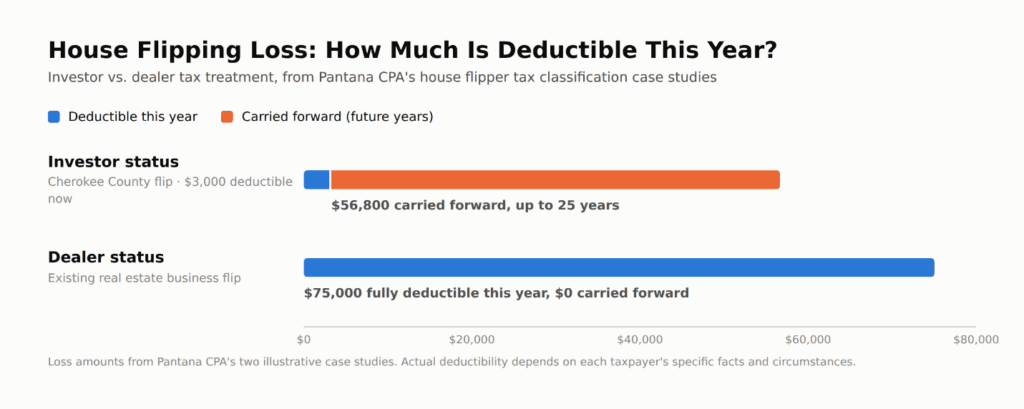
- Real estate dealer: If the property is inventory of a trade or business, gain is ordinary income and loss is an ordinary loss: fully deductible against wages, interest, or any other income in the year it occurs, with no dollar cap.
- Real estate investor: If the property is held for investment, it’s a capital asset. Gain gets favorable capital gains rates, but loss is a capital loss, and under IRC Section 1211(b), an individual can only deduct up to $3,000 per year ($1,500 if married filing separately) against ordinary income. Anything beyond that carries forward to future years under IRC Section 1212.
Neither status is something you elect on a form. It’s determined by facts and circumstances, and this is the part that surprises most first-time flippers: courts have consistently held that a single, isolated sale leans toward investor treatment, not dealer treatment, unless the surrounding facts show you’re actually operating a flipping business.
How Courts Actually Draw the Line
The leading case is United States v. Winthrop, 417 F.2d 905 (5th Cir. 1969), where the Fifth Circuit held the test turns on whether selling the property was the taxpayer’s primary purpose in holding it, and looked at evidence including:
- The frequency, continuity, and substantiality of sales over time
- Whether the taxpayer advertised the property or maintained anything resembling a sales operation
- Whether profits were reinvested into more real estate (a pattern) or treated as a one-time event
- The purpose behind the original purchase
- Whether the income was the taxpayer’s primary source of income or occupation
Fourteen years later, in Byram v. United States, 705 F.2d 1418 (5th Cir. 1983), the same court sharpened the line further, distinguishing business-like, continuous selling activity from what is fundamentally an investment sale, reinforcing that volume and continuity, not intent alone, is what pushes a taxpayer into dealer territory.
A companion case, Suburban Realty Co. v. United States, 615 F.2d 171 (5th Cir. 1980), organized the inquiry into seven factors: the nature and purpose of acquisition and the duration of ownership; the extent and nature of the taxpayer’s efforts to sell; the number, extent, continuity, and substantiality of sales; the extent of subdividing, developing, and advertising to increase sales; the use of a business office for sales; the degree of supervision over any sales agents; and the time and effort habitually devoted to sales. The court was explicit that the third factor, frequency and substantiality of sales, carries the most weight of the seven, though no single factor is automatically controlling.
Applied to the case above: one property, no advertising, no sales office, a day job untouched, a licensed general contractor doing the work, and a traditional listing agent handling the sale. There was no pattern of frequency or continuity, because there was no second transaction to compare it to. Under Winthrop, Byram, and Suburban Realty, that fact pattern points toward investor status, not dealer status, however much the client felt like he was “running a flipping business” in the moment.
What That Meant for the $59,800 Loss
Because the property was classified as a capital asset rather than dealer inventory, the loss was reported as a capital loss on Schedule D, not an ordinary business loss on Schedule C. The practical result:
- $3,000 of the loss offset his ordinary W-2 income for the current tax year.
- The remaining $56,800 became a capital loss carryforward under IRC Section 1212, available to offset capital gains (including gains on future flips, stock sales, or other investment property) in future years, and then up to $3,000 a year against ordinary income after that, until it’s used up.
That was not the answer the client wanted to hear in April. It was, however, the correct answer, and the one that keeps him from an amended return, penalties, and interest if the IRS later disagreed with a fully-deducted ordinary loss that the facts didn’t support. Pantana CPA built out the multi-year carryforward schedule so the $56,800 doesn’t get lost or miscalculated on next year’s return, and modeled two paths for how his tax outcome changes if he flips a second and third property within the next 18 months.
Not sure whether your next flip lands you in dealer or investor territory?
Why the Classification Question Gets Bigger, Not Smaller, After Flip #1
Here’s the part most first-time flippers don’t see coming: dealer status isn’t just a bad thing to avoid. If this client goes on to flip three, four, or six houses over the next two years (buying with the clear intent to resell, marketing himself as a flipper, and treating it as his primary business activity), the same Winthrop frequency-and-continuity factors that classified his first flip as investor property could tip his later flips (and potentially reclassify the pattern as a whole) into dealer territory. At that point:
- Gains become ordinary income taxed at his marginal rate instead of capital gains rates.
- Net profit becomes subject to self-employment tax, 15.3% on top of income tax, under the Schedule SE rules the IRS applies to a trade or business.
- He loses access to the installment sale method under IRC Section 453(b)(2), which is unavailable to dealer property regardless of how the sale is structured.
- He also loses access to Section 1031 like-kind exchanges: under IRC Section 1031(a)(2), the exchange rules do not apply to real property held primarily for sale.
- But losses on future flips, if the pattern is established, become fully deductible ordinary losses again, with no $3,000 ceiling.
In other words, the right classification isn’t a one-time compliance checkbox. It’s a moving target that should be revisited before every flip, not after the closing statement arrives. That’s the substantial difference the classification question makes, not just in the year of the loss, but for every flip that follows.
One more catch is worth stating plainly: dealer status is a package deal, not a switch to flip year by year. A taxpayer cannot claim dealer treatment in a loss year and then claim investor treatment on the next flip simply because it turns a profit. Taking inconsistent positions on the same ongoing activity to minimize tax in both directions is what the IRS calls a whipsaw argument, and it undermines the credibility of both claims. If the genuine business plan is to buy, rehab, and sell properties repeatedly, dealer treatment is the honest position in both directions: full ordinary-loss deductions when a flip loses money, and ordinary income taxed at marginal rates plus self-employment tax when one succeeds.
A Different Fact Pattern: When You Already Run a Real Estate Business
The frequency-and-substantiality factor is why most first-time flippers default to investor treatment. But it is not the whole test, and it does not automatically sink every first-time flipper. Consider a different client profile: a retired architect who holds an active real estate license and reports $50,000 to $100,000 a year in commissions on Schedule C. In April 2025, he bought a derelict older house with the explicit intent to fully restore it, sell it, and roll the proceeds into the next one, and the one after that. The rehab took 11 months. He sold the finished house this year, but renovation costs, carrying costs, and a market that had softened by the time the house was ready turned the deal into a $75,000 loss.
| Purchase price (April 2025) | $520,000 |
| Renovation costs (11 months) | $103,000 |
| Carrying costs (11 months) | $22,000 |
| Total cost basis | $645,000 |
| Sale price | $610,000 |
| Selling costs (commission + closing) | $40,000 |
| Net proceeds | $570,000 |
| Total loss | ($75,000) |
On paper, this is also a first flip with no sales history, the weakest fact under Suburban Realty. But the rest of his facts point the other way. He bought the property to fix it up and resell it at a profit, not to hold it for appreciation. He improved it continuously for the entire ownership period, which gives him the attributes of a builder (home builders are generally treated as dealers), and courts have long viewed substantial development activity as strong evidence that a property was inventory in process rather than an investment parked for the market to lift it. He listed it as soon as the rehab was finished despite a soft market, which is business behavior, not investor behavior, since an investor is more inclined to wait the market out. He ran the project in a businesslike, professional manner. And critically, he already operates a real estate trade or business as a licensed agent reporting commissions on Schedule C, so the flip is a natural extension of an existing business rather than a stand-alone side project.
There is direct support for treating a single property as a trade or business: in Morley v. Commissioner, 87 T.C. 1206 (1986), the Tax Court addressed how one piece of real property under active development can itself constitute a trade or business. That does not make this an easy call. The IRS will press hardest on the one-sale fact pattern, and a documented, pre-existing business plan to buy, rehab, and sell repeatedly strengthens the position considerably. But between the acquisition intent, the builder-level improvement activity, the immediate listing effort, and the existing licensed real estate business, dealer treatment is a defensible position here, not a stretch, even without a sales track record.
The self-employment tax wrinkle
Dealer treatment carries an extra benefit in a loss year for someone who already has self-employment income from real estate. Under IRC Section 1402(a), net earnings from self-employment are computed across all of a taxpayer’s trades or businesses together. A dealer-classified flipping loss that combines with existing 1099 commission income on the same real estate activity reduces net self-employment earnings, which lowers self-employment tax along with income tax, something an investor’s capital loss can never do.
Building the Record Before the IRS Asks for It
Dealer classification is a facts-and-circumstances determination, which means the paper trail built during the project, not after an audit notice arrives, is what ultimately wins or loses the argument. Pantana CPA recommends every flipper claiming dealer status keep:
- A written business plan describing the intent to buy, rehab, and sell properties on an ongoing basis, dated before or at the start of the project.
- A separate bank account and bookkeeping for the flipping activity, kept apart from personal finances or other business lines.
- A log of hours worked and tasks performed on the renovation and sale.
- Prompt listing of the property for sale as soon as the rehab is substantially complete.
- Consistent, year-after-year reporting of the activity as a Schedule C business, not an occasional side transaction.
None of these alone decides the case. Together, they are what turns “I consider this a business” into a position the facts actually support.
Pantana CPA helps flippers across Acworth and Cherokee County document the right classification before an IRS notice arrives
Frequently Asked Questions: House Flipping Taxes
If I only flip one house, am I automatically treated as a real estate dealer?
No. A single, isolated sale generally supports investor treatment, not dealer treatment, under the frequency-and-continuity test set out in United States v. Winthrop, 417 F.2d 905 (5th Cir. 1969). Dealer status typically requires a pattern of activity (repeated purchases and sales, advertising, or treating flipping as your primary trade or business), not just the intent to make a profit on one property.
How much of a house-flipping loss can I actually deduct this year?
If your flip is classified as investment property (the default for most first-time or occasional flippers), your loss is a capital loss. Under IRC Section 1211(b), you can deduct up to $3,000 per year ($1,500 if married filing separately) against ordinary income, with the rest carried forward under IRC Section 1212 to offset future capital gains and, eventually, more ordinary income. If your flipping activity rises to the level of a trade or business (dealer status), the loss is an ordinary loss with no annual dollar cap, deductible in full against other income in the year it occurs.
Can I just elect to be treated as a dealer so I can deduct my full loss this year?
No. Dealer versus investor status is not an election you make on a tax form. It’s determined by the facts and circumstances of how you acquired, held, marketed, and sold the property, based on factors from case law including United States v. Winthrop and Byram v. United States, 705 F.2d 1418 (5th Cir. 1983). What you can do is document the facts accurately (how the property was acquired, how it was held, your level of involvement, and whether you have a pattern of similar transactions) so your return reflects the classification the facts actually support.
Does flipping houses trigger self-employment tax?
Only if you’re classified as a dealer running a real estate trade or business. Dealer-classified net profit is generally subject to self-employment tax (15.3%) in addition to ordinary income tax, on top of losing capital gains rates on the sale. Investor-classified flips are not subject to self-employment tax, but as noted above, investor losses face the $3,000 annual cap. Neither status is purely “better”; it depends on whether you’re profitable and how consistently you’re flipping.
If my first flip is classified as an investment loss, does that lock in how the IRS treats my next flip?
No. Classification is evaluated property by property and is based on the facts surrounding each transaction, though a consistent pattern across multiple flips is exactly what can shift you from investor to dealer status over time. A taxpayer who flips one house casually and a taxpayer who flips six houses a year while advertising as a flipper can receive different treatment even in the same tax year. That’s why the classification question should be revisited before each new project, not decided once and forgotten.
I already run a real estate business. Does that change how my first flip is classified?
It can. Frequency and substantiality of sales is the most heavily weighted factor courts use (Suburban Realty Co. v. United States, 615 F.2d 171 (5th Cir. 1980)), and a single sale is a real weakness on that factor alone. But it is not the only factor. A documented intent to resell at the time of purchase, continuous builder-level improvement activity, prompt listing after the rehab, businesslike conduct, and, importantly, an existing real estate trade or business, such as an active broker or agent license with Schedule C commission income, can support dealer treatment even on a first flip. Morley v. Commissioner, 87 T.C. 1206 (1986), supports the idea that a single property under active development can itself constitute a trade or business. This is a facts-and-circumstances call, not a guarantee, so document the business intent from day one.
Get Your Flip Classified Correctly Before It Costs You
Whether this is your first flip or your fifth, the dealer-versus-investor determination affects how much of a loss you can deduct this year, whether self-employment tax applies to your gains, and which tax elections are even available to you. Pantana CPA works with real estate investors and flippers throughout Acworth, Cherokee County, and the greater Cobb County area to document the right classification before the return is filed, not after an IRS notice arrives.
Primary Sources
- 26 U.S. Code § 1221: Capital Asset Defined
- 26 U.S. Code § 1211: Limitation on Capital Losses
- 26 U.S. Code § 1212: Capital Loss Carrybacks and Carryovers
- 26 U.S. Code § 453(b)(2): Installment Method Exclusion for Dealer Property
- Malat v. Riddell, 383 U.S. 569 (1966)
- Suburban Realty Co. v. United States, 615 F.2d 171 (5th Cir. 1980)
- Morley v. Commissioner, 87 T.C. 1206 (1986)
- 26 U.S. Code § 1031(a)(2): Like-Kind Exchange Exclusion for Dealer Property
- 26 U.S. Code § 1402(a): Net Earnings From Self-Employment
- IRS Topic No. 409: Capital Gains and Losses
- IRS Publication 544: Sales and Other Dispositions of Assets
- United States v. Winthrop, 417 F.2d 905 (5th Cir. 1969)
- Byram v. United States, 705 F.2d 1418 (5th Cir. 1983)
- ATTOM Data Solutions: Q1 2026 U.S. Home Flipping Report
- Redfin: Cherokee County, GA Housing Market Data
- TPG Sells: Cherokee County, GA Market Update, April 2026
This article is for general informational purposes and does not constitute tax or legal advice. The client scenario described is an illustrative composite based on common fact patterns Pantana CPA sees in real estate tax engagements; details have been adjusted for this example. Every flip’s classification depends on its own specific facts. Always consult a tax professional before filing.
Let's Get Your Financials In Line With Your Goals
Continue Reading

Should You Buy a Vehicle Before Year End?

Why You Should Give Your Business a COLA (Cost of Living Adjustment) in 2027

2026 Year-End Tax Planning for Business Owners: 12 Proven Moves to Protect Your QBI Deduction and Avoid a Costly Tax Surprise

Giving Inheritance While You Are Still Living: The 2026 Tax Playbook Families Are Asking About

The Premium Tax Credit in 2026: Who Qualifies, Who Gets the Subsidy, and the Warnings Every Taxpayer Should Hear

You Own a Business Overseas – A Guide to what you need to know

You Started an LLC. Did You Tell Your CPA? What Your Accountant Needs to Know (and Why It Matters)